


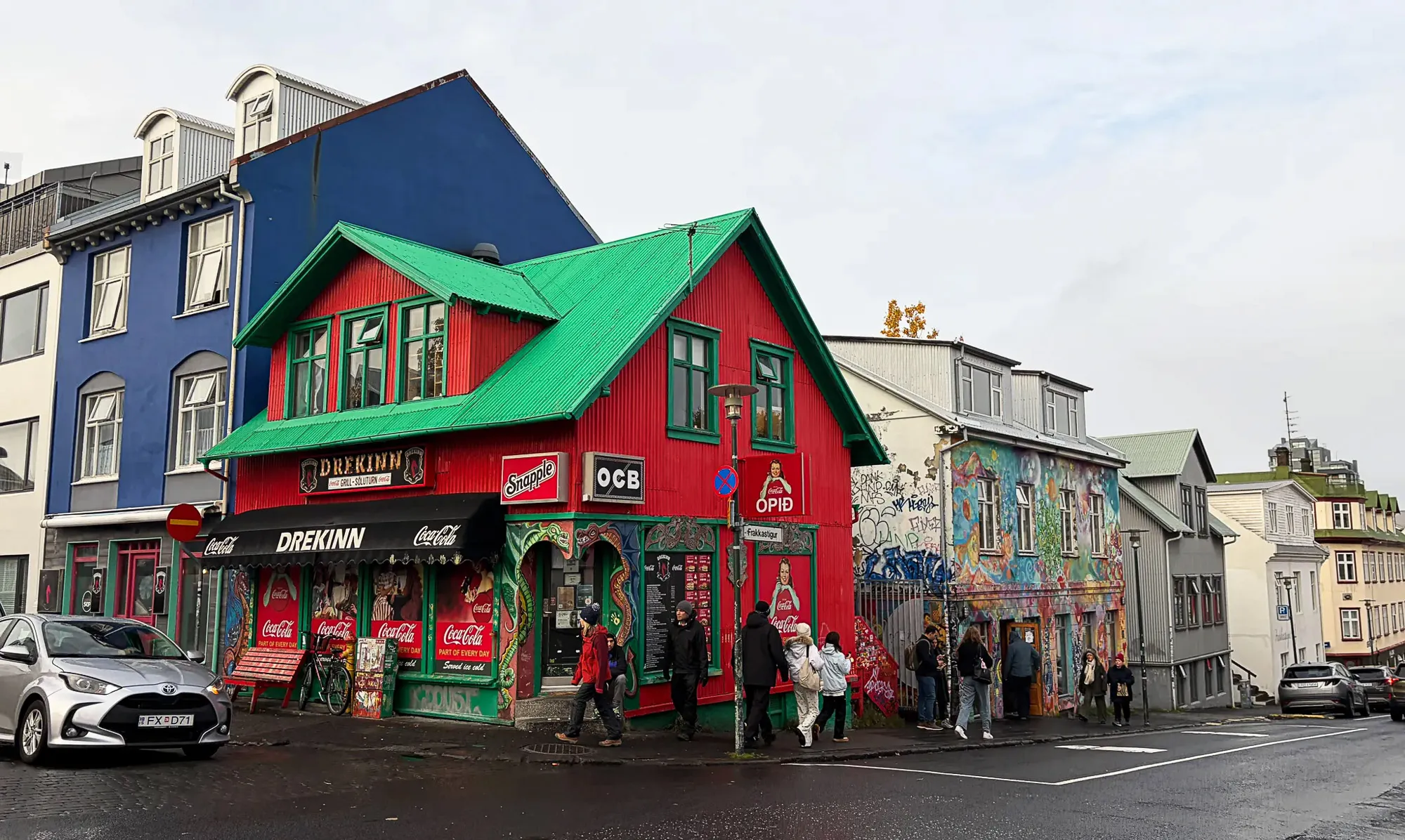
Jude Swagel is a third-year B.A. in Design student pursuing a Minor in Art History. He recently attended the AGI Open in Reykjavík, Iceland in early October. Below, he writes about how he pursued funding for this experience and the professional development opportunities the conference offered to him.
The Alliance Graphique Internationale is a global consortium of designers with 543 members hailing from 47 countries. Since 2010, the alliance has put on the AGI Open, an annual two-day design conference hosted by different alliance members in their home city. This year, the conference was hosted by AGI members Hjalti Karlsson and Jan Wilker of karlssonwilker in Reykjavík.
After learning of the event this summer, I quickly drafted a proposal for department funding and applied for a scholarship from the Professional Development Travel Fund in COFA Career Services. I figured I would be able to cover the trip between the two channels of support and that leveraging each to argue for why I should receive the other source’s funding would emphasize the seriousness of my proposal. I was incredibly lucky and grateful to receive both grants, and I promptly asked my brother to ship his old winter coat to my Austin apartment.
The conference drew a diverse, international range of design and art practitioners. I met graphic designers from Amsterdam, strategists from Reykjavík and publishers from Paris. There was a distinct sense that these mostly European practitioners viewed design as a high art, rather than a purely commercial enterprise of branding or marketing that may be more common in the United States. People were warm, friendly and excited to meet me — part of this may have been because I was seemingly the only American student in attendance.
Conference speakers spoke on a vast range of topics. Icelandic illustrator Siggi Eggertson discussed the role of AI in making art. UI Designer Irene Pereyra showcased her work making blueprints for future visions of Europe. Designer and illustrator Christoph Niemann conveyed his unique curiosity-driven career and process through multiple case studies, with work ranging from a weekly sketch series to subway station murals in Germany.
The entire experience was exhilarating and incredibly educational. From arriving in Reykjavík at 5 a.m. on three hours of sleep and having to run to my hostel to get ready for a 9 to 5 day of presentations, to bumping into European designers whose design I admired in a ramen shop, each day was full of new experiences and perspectives. I learned just as much from casual conversations with fellow conference attendees as I did from the concentrated hours of presentations.
I felt compelled to take notes on each talk, curious to see if I could connect my takeaways into a larger discussion on design and creativity. I turned the resulting synthesis into my first feature-length article on design, titled “What Makes Design Worth It.” The piece links ideas from various conference speakers into a manifesto-like argument, using additional online lectures and articles to flesh out my claims.
My core takeaways from the conference — as presented in my article — were these:
Technology can expand our capabilities and reduce the friction of creating, but the process of making — as inefficient or nonlinear as it may be — remains worth our time. Not just for a final picture, but for how it reshapes our way of seeing. That shift in perspective helps us give form to possibilities beyond the existing and expected.
Explore the extended article here.