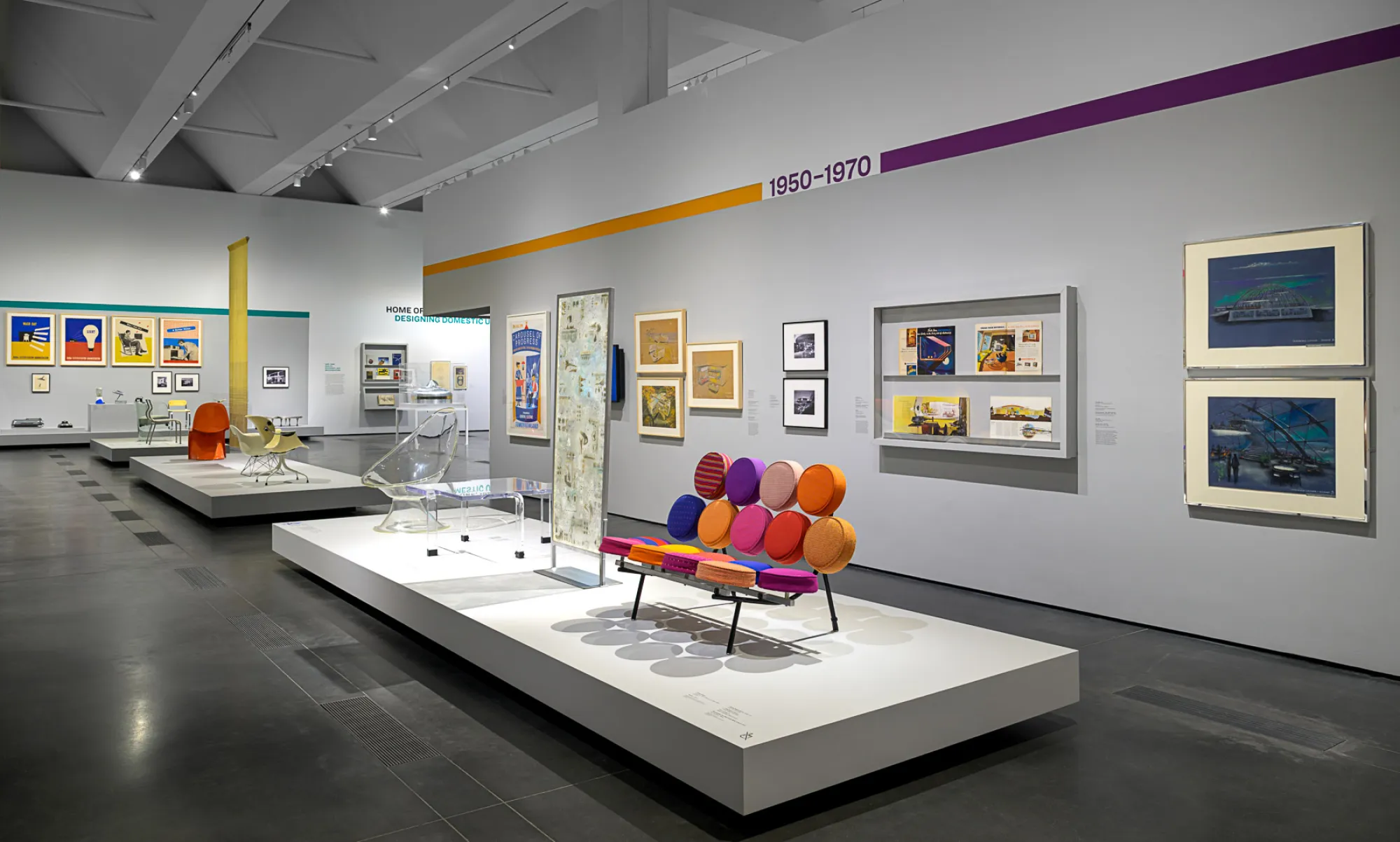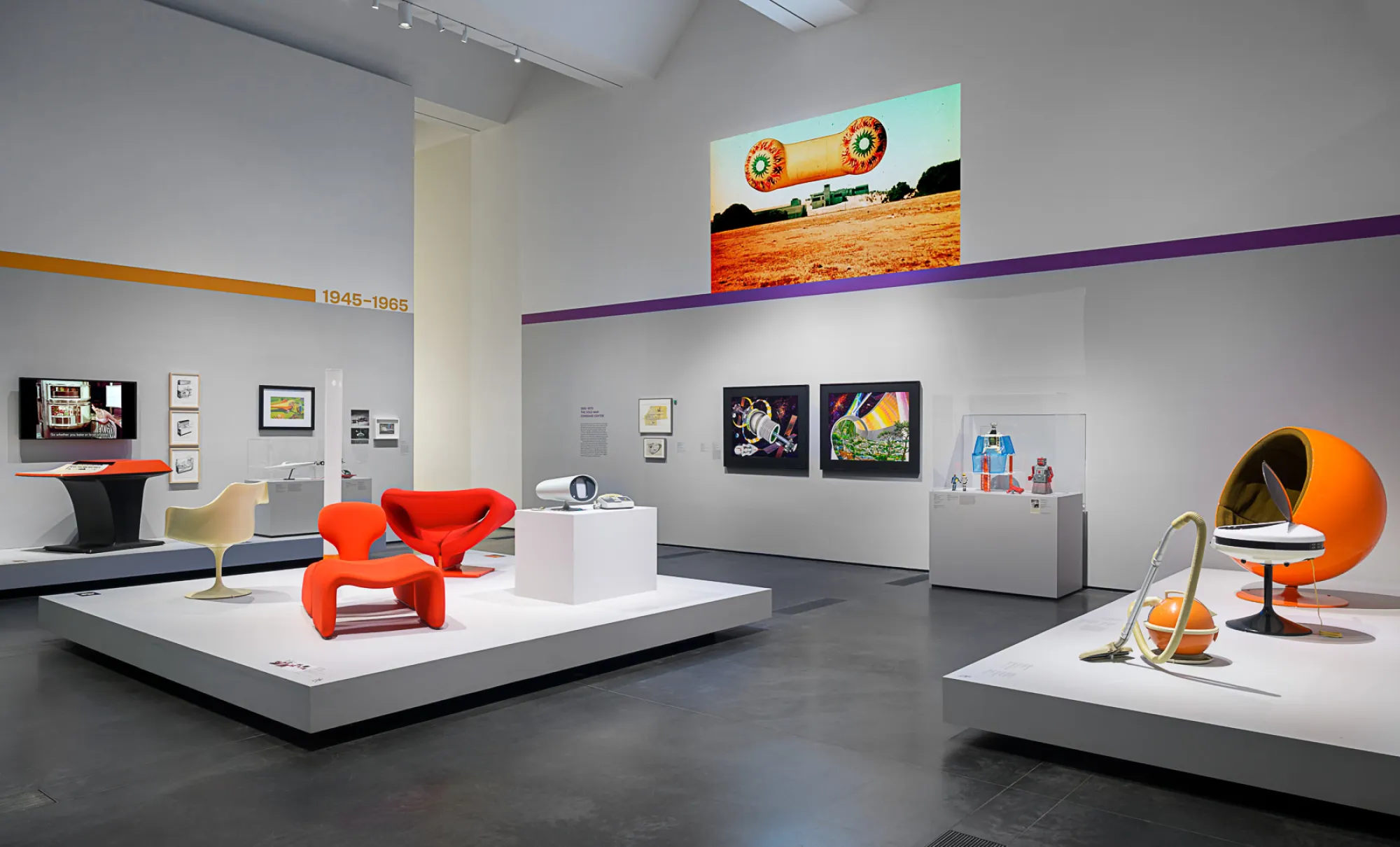
After six years of work, Associate Professor Monica Penick saw a project come to fruition this fall as the exhibition Home of the Future, 1925–1985: Designing Domestic Utopias opened in September at the Los Angeles County Museum of Art (LACMA).
The show, which runs through March 14, was curated by Wendy Kaplan, department head and curator of Decorative Arts and Design at LACMA. Penick and UT Architecture Professor Christopher Long served as exhibition advisors and contributed original essays to a catalog with the same name.
Penick and Long had previously collaborated as curators on The Rise of Everyday Design: The Arts and Crafts Movement in Britain and America at the Harry Ransom Center. The idea for the LACMA show formed out of a conversation with Kaplan when she was visiting as a keynote speaker for their Ransom Center exhibition.
Penick worked with Kaplan and Long to frame the historical narrative of the exhibition, which was organized into chronological sections. Her expertise is in post-World War II American design, and she focused on the sections of the exhibition covering 1945–1970, titled “1945-1965 Plastics, Push Buttons, and Prefabrication” and 1950-1970: The Cold War Command Center.” Penick conducted archival and object-based research for these sections, and helped select the items that would be included in the show.

“This was an incredible opportunity for me, both as learning experience and as a way to get my research out into the world to make a larger impact,” Penick said. “Often, my work is published in academic presses that circulate to smaller audiences, but to get to work on a show that will be visited by an estimated 100,000 people through the exhibition is exciting and so rewarding.”
Penick’s work on the exhibition and the catalogue has been supported by funding from UT Austin, the College of Fine Arts, LACMA, and the Getty Foundation. Over the course of several years, she conducted research at the AT&T archives, the Kohler archives, the GE archives, the Cooper Hewitt and the Museum of Modern Art. Her work on the exhibition also led her scholarly research in new directions. Some items that she spent time researching for the exhibition may have received brief coverage in an exhibition label or catalogue essay, but she’ll continue to write about these in depth as chapters in a forthcoming book.
In the exhibition catalog, Penick penned two essays, “Tomorrow’s House,” which explores designing homes of the future in the immediate postwar years, and “New Frontiers,” which covers how designers imagined living in the future in unusual locations — underground, undersea and even outer space.
“It’s a beautiful book with original scholarship,” Penick said. “It’s a great companion piece, and we’re all really proud of the contributions of the catalog and how it supports the show.”