


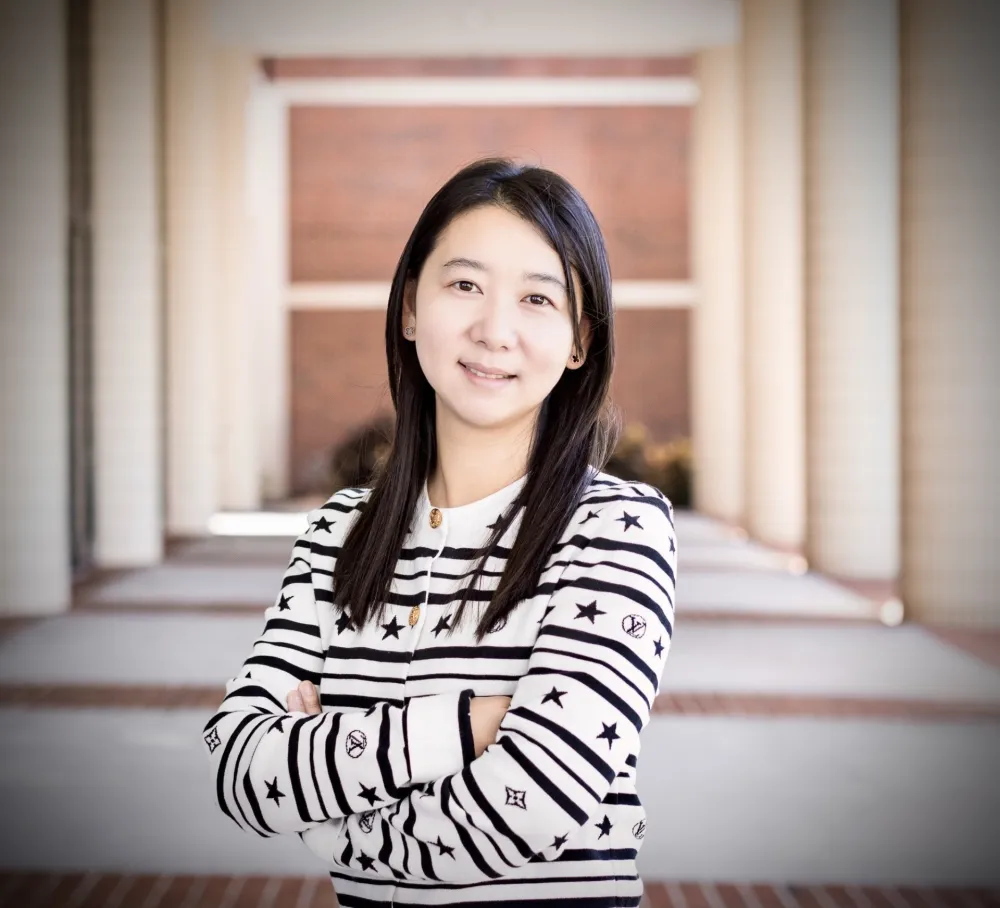
Design Assistant Professor of Practice Wen (Vivian) Ye recently received a Good Systems Seed grant for an interdisciplinary project to develop an AI-enabled mobility assistance system that improves safety and independence for blind and visually impaired people interacting with autonomous vehicles.
Ye is co-principal investigator for the project with Civil Engineering Assistant Professor Zhaomiao Guo and Computer Science Associate Professor Qixing Huang. The team was one of six selected from across campus to advance human-centered AI.
Autonomous vehicles (AVs) offer opportunities to improve efficiency and safety in urban transportation. However, ensuring equitable access remains a critical challenge, particularly for people who are blind or visually impaired, whose needs and perspectives are often overlooked in AV design and deployment.
In the project, Ye and the team will explore how human–AI partnerships can enable blind and visually impaired travelers to use AV-based transportation confidently and independently. The team will develop, prototype and evaluate an AI-enabled, context-aware device that supports nonvisual sensing, enhances situational awareness and builds trust in interactions with AVs.
Ye leads the project’s design research and human-centered design components, exploring how users’ experiences and perspectives can inform more accessible transportation technologies. The team brings together her design expertise, Guo’s research in transportation engineering and Huang’s work in artificial intelligence.
Ye has an ongoing partnership with the Texas School for the Blind and Visually Impaired, where she conducted participatory design sessions with students and instructors to understand everyday mobility challenges, communication preferences and expectations for interacting with AVs. Insights from that research will guide the design of an AI-enabled wearable device or application.
Through iterative prototyping and testing with participants, Ye will examine how the technology’s form, usability and communication interfaces can support independence, trust and dignity, with particular attention to comfort if developed as a wearable device. Her work places users’ priorities at the center of development, shaping both the information the technology provides and how people experience it.
The team’s paper “Beyond the Ride: A Full-Journey Framework for Multimodal Accessibility in Autonomous Vehicles for Blind and Low-Vision Travelers” has been accepted for presentation at the Transportation Research Board Annual Meeting in January in Washington, D.C.